Disclosure: this post contains affiliate links. As an Amazon Associate I earn from qualifying purchases, at no extra cost to you.
A film treatment is your whole story told in plain prose, from the first image to the last, with almost no dialogue. You write it before the screenplay, so you can find out whether the story works while it still costs you pages and not weeks.
This guide explains what goes in a treatment, how long it should be, and how it differs from a synopsis, an outline and a pitch deck. It includes a free fill-in treatment template and a short worked example based on a classic public-domain story.
What is a film treatment?
A treatment tells the story the way an audience will experience it, in order. It names the characters, shows what they want, follows every major turn and reveals the ending. It is written in prose, not in screenplay format, and it reads best when it is concrete and visual: what we see, what changes, and why we care.
Most treatments are written in present tense, the same way a screenplay describes action. "Della counts her coins twice" works better than "Della counted her coins twice," because the reader stays in the moment.
Treatment vs logline, synopsis, outline and scriptment
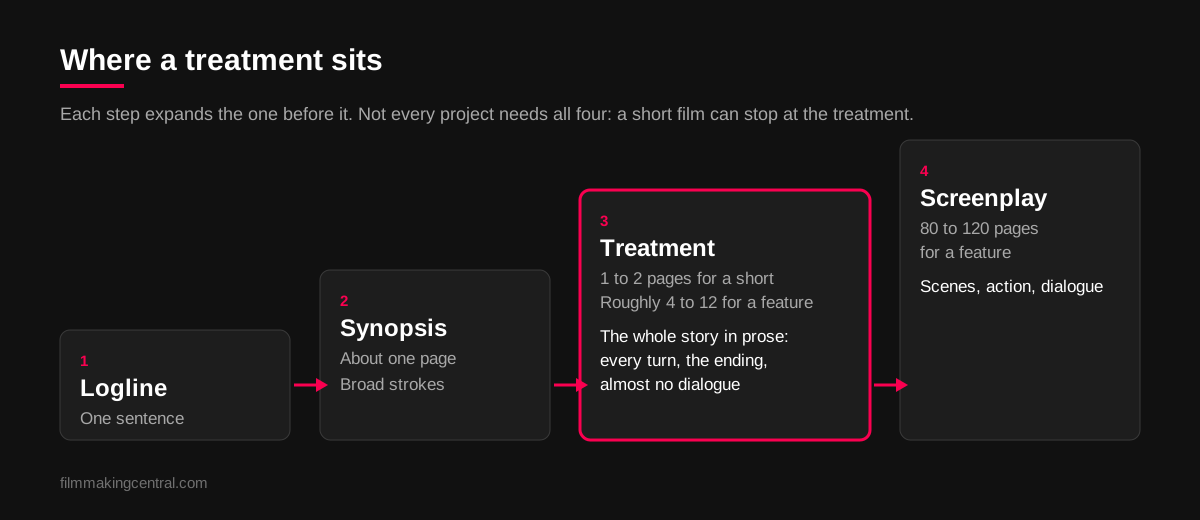
These terms get mixed up, and even working writers use them inconsistently, so the labels matter less than the purpose. Here is the useful way to separate them:
| Document | What it is | Typical length | Main reader |
|---|---|---|---|
| Logline | The story in one sentence | One sentence | Anyone you pitch in a hallway |
| Synopsis | The broad strokes of the story | About one page | Someone deciding whether to read more |
| Outline | A scene-by-scene list, often bullets | A page or several | You and your collaborators |
| Treatment | The whole story in prose, every major beat, with the ending | A few pages | Producers, funders, collaborators, and you |
| Scriptment | A treatment with some slug lines and key lines of dialogue | Longer than a treatment | Writers who want to stay close to script form |
If you do not have a logline yet, our logline generator is a good place to start. If you are still working out structure, see our screenwriting guide, which covers where a treatment fits in the writing process.
When do you need a film treatment?
You do not always need one, but it earns its place in four situations:
- Before you write the script. It is much faster to fix a broken second act in a three-page treatment than in a 90-page draft.
- Pitching. Producers, agents, film funds and festival labs often ask for a treatment, a logline and a short bio before they read a script. A treatment rarely sells a project on its own, but it gets the conversation started.
- Getting a team aligned. A director, a cinematographer and a producer can all read three pages in ten minutes and talk about the same film.
- Planning a no-budget shoot. Writing the story down in prose shows you early how many locations, actors and special requirements you are really signing up for. If your resources are tight, pair this with our guide to guerrilla filmmaking techniques.
How long should a film treatment be?
Advice varies, which is itself a clue that the right answer depends on what you are using it for.
- Short film: one to two pages is usually enough. A half page can do for a very short piece.
- Feature film: roughly four to twelve pages is a common range. Some writers pitch with one-page versions, and some development treatments run longer.
- TV pilot: cover the pilot episode itself. A treatment for a series is a different document, closer to a show bible.
The rule of thumb is simple: keep it as short as you can while still telling the whole story. Every page you add is another page a busy reader can stop reading.
What goes in a film treatment
A treatment has no single official format, but strong ones tend to include the same building blocks. Our free template follows this order:
- Title block. Title, your name, contact details, the date of the draft and the format (short, feature, series).
- Logline. One sentence with a protagonist, a goal, an obstacle and what is at stake.
- Overview. Genre, tone, runtime or page target, setting, and two or three comparable films with the one thing you borrow from each.
- Main characters. Who they are, what they want, and what stops them. Three or four characters is plenty.
- The story. The heart of the document: an opening image or scene, Act One, Act Two, Act Three and a final image.
- Look and sound (optional). A few images or ideas about color, light, camera feel and music. Useful when pitching or briefing a team.
- Why this story, why now (optional). What makes it urgent, and why you are the right person to make it.
- Audience (optional). Who it is for, and where you hope to show it.
How to write a film treatment, step by step
1. Start with a one-sentence logline
If you cannot say the story in one sentence, you are not ready for three pages. Write the logline first, then rewrite it until it names a protagonist, a goal, an obstacle and the stakes.
2. List the major turning points
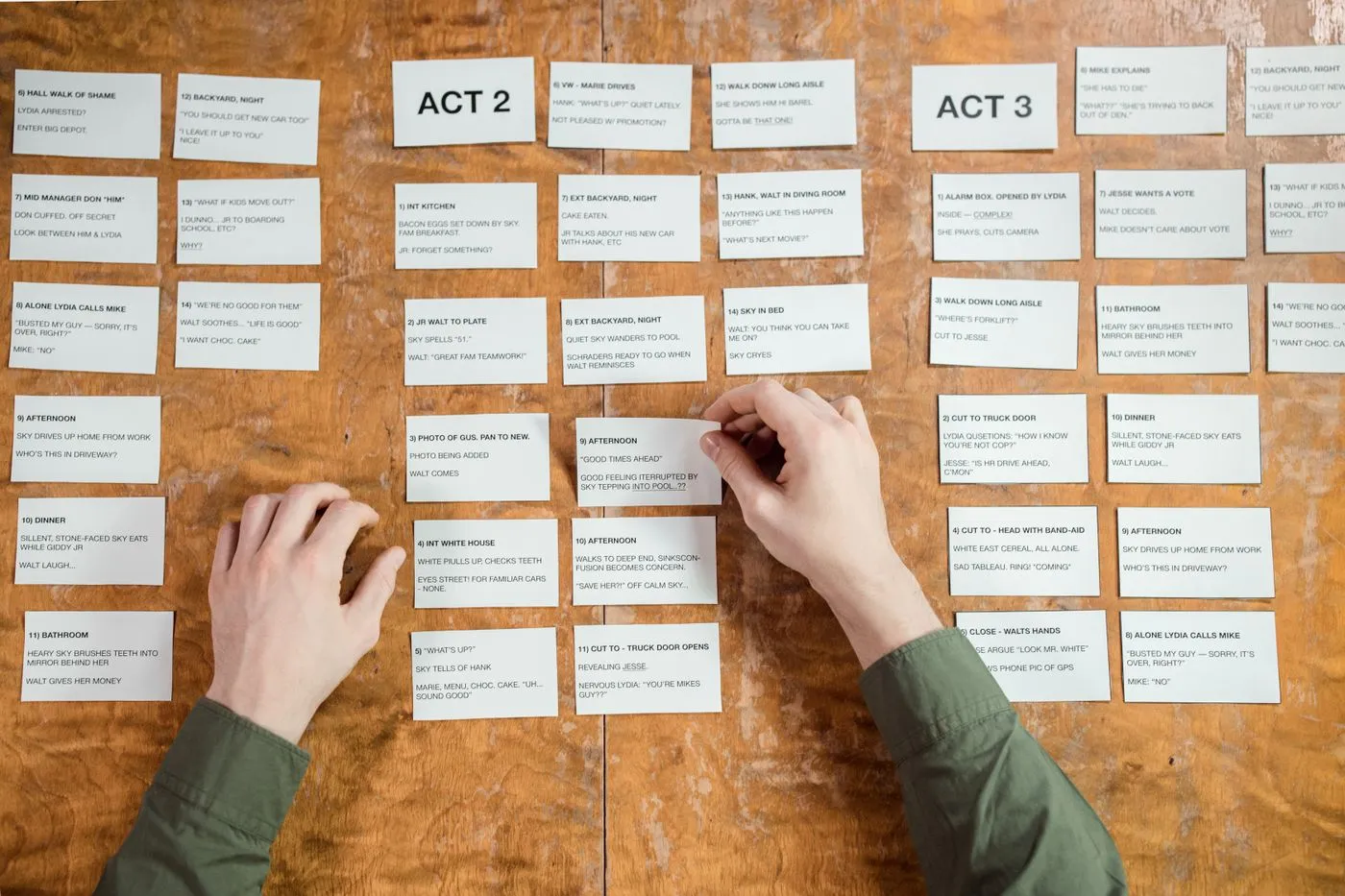
Before you write any prose, jot down the beats on index cards or a single page: the opening situation, the event that disrupts it, the decision to act, the midpoint turn, the lowest moment, the final choice and the ending. A pack of index cards on a table is hard to beat for moving beats around.
3. Write the opening image
Open with one concrete scene or image that shows who the protagonist is and what normal looks like. A reader should be able to picture it.
4. Tell Act One
Set up the world, the problem, and the moment the protagonist commits to doing something about it. Keep it tight. In a feature, Act One is often roughly a quarter of the story, so it should not take up most of your pages.
5. Tell Act Two
This is the longest section, and the one most treatments get wrong. Show obstacles that escalate, a turn near the middle that changes what the protagonist wants or knows, and a low point where it looks like they will fail. If this part feels thin in prose, it will feel thin on screen.
6. Tell Act Three and reveal the ending
Show the final choice, the confrontation and the resolution. Tell the reader how it ends. A treatment is not a trailer, and a reader who cannot see the ending cannot judge the story.
7. Cut, then read it aloud
Remove anything that does not change the story. Then read the treatment out loud. Wherever you stumble or get bored, the reader will too.
A worked example: a short film treatment
Here is a treatment for a short film, adapted from a classic public-domain story: "The Gift of the Magi" by O. Henry, published in 1905. We set it in the present day, in one apartment and one small shop, to keep it affordable. This is our own adaptation, kept to about one page.
THE GIFT
Logline: On Christmas Eve, a broke young wife sells her hair to buy her husband a chain for the one heirloom he owns, not knowing he has just sold that heirloom to buy her a set of combs.
Format: Short film, about 8 minutes. Tone: Warm, wry and bittersweet. Setting: One small apartment and one hair shop, present day. Comparable films: The quiet romance of a short like Two Distant Strangers in its compression, and the small-scale humor of a good holiday short.
Characters: DELLA (late twenties) is practical and proud and has long, beautiful hair she rarely admits she loves. JIM (late twenties) is gentle and tired from a job that pays too little, and he treasures his grandfather's pocket watch, which has no chain.
Opening image: Della counts a jar of coins on the kitchen table. She counts it twice. It is not enough, and she knows it.
Act One: It is Christmas Eve. Della has saved for weeks to buy Jim something worthy of him, and the pile is still small. She catches sight of her reflection, then of her hair. She hesitates, and then walks out into the cold.
Act Two: In a tiny hair shop, a stylist offers her cash for the hair. Della sits and does not look in the mirror. Outside, she walks stronger and lighter, and finds a plain watch chain in a shop window, exactly right for the watch. She pays and runs home. Meanwhile, Jim climbs the stairs of a pawn shop, hands over his grandfather's watch and walks out with a small velvet box. At home, Della practices her smile in the mirror and hides the chain behind her back.
Act Three: Jim comes in and stops. He stares at her short hair and does not speak. Della laughs nervously and gives him the chain. He gives her the box: a set of combs, the very ones she once admired in a shop window. She cannot wear them now. He cannot wear the chain. They look at their gifts, then at each other.
Final image: Jim lifts Della's hand and holds it. On the table, the combs sit beside the chain. They both start to laugh, and the camera holds on the two of them in the ordinary light of the kitchen.
Notice what this treatment does. It tells the whole story in about 350 words. It uses present tense. It reveals the ending. There is almost no dialogue, and everything described can be filmed.
Free film treatment template (PDF)
We made a printable three-page template that follows the structure above. Page one covers the title block, logline, overview, characters and world. Page two guides you through the story in acts. Page three has optional look, sound and pitch sections plus a length guide and a final checklist.
Download the free film treatment template (PDF)
Print it, or fill it in on a screen. If you prefer to work in a word processor, copy the headings and use them as your outline.
Tips for writing a treatment that reads well
- Write in present tense. It keeps the reader in the moment and matches how screenplays describe action.
- Show, do not explain. "Jim stares at her hair and says nothing" beats "Jim is shocked."
- Skip camera directions. Leave shots, angles and edits for the shot list and storyboard.
- Use dialogue sparingly. One line that carries a scene is fine. A conversation is a sign you are writing the script early.
- Name characters in caps the first time. It helps a skimming reader keep track, and it matches script convention.
- Keep your voice. A treatment can be as stylish as the film. Dry, funny or tense prose tells a producer what the movie will feel like.
Common treatment mistakes
- Hiding the ending. Readers need to judge whether the story works, so tell them how it ends.
- A long, boring Act One. If the first third of your pages is setup, trim it.
- Summarizing feelings instead of events. "The two grow closer" is not an event. Say what happens that brings them closer.
- Listing scenes like an outline. A treatment is prose. Connect the beats with cause and effect.
- Writing too much. If you have twelve pages for a ten-minute short, you are probably writing a script in disguise.
- Ignoring practical limits. If you plan to shoot it yourself, note the locations and cast size honestly. Your budget starts here, as we explain in our film budgeting guide.
A different document: the director's treatment
In commercials, branded content and music videos, a "treatment" often means something else. Directors write a director's treatment to win a job. It is usually a designed deck of a few pages, with your concept, tone, visual references, casting ideas and approach to the shoot, rather than a prose telling of a plot.
The ideas carry over: be specific, be visual and keep it short. But the format is closer to a pitch deck than to the story document in this guide. If you are making a story film, use the template here. If you are pitching a client, build a visual deck with the same logline-first discipline.
Paper or software?
Any word processor works for a treatment. A Google Doc or a Word file is easy to share and comment on, and a few pages need no special tools. Dedicated writing software is useful once you move on to the script, and the pre-production tools in our guide to pre-production software can help you take the story forward into scheduling and budgeting.
What comes after the treatment
Once the treatment holds up, you can write the screenplay with a clear map. After that, the pre-production chain begins: a script breakdown to list everything you need to shoot each scene, a budget, a schedule, and a call sheet for each shoot day.
Quick checklist
- The logline is one sentence and names the protagonist, goal, obstacle and stakes.
- The whole story is told, including the ending.
- It is in present tense and every beat can be filmed.
- Dialogue is rare and purposeful.
- Act Two has escalating obstacles and a clear turn near the middle.
- Nothing is in there that does not change the story.
- You read it aloud and trimmed the dull parts.
Final thoughts
A treatment is the cheapest place in filmmaking to make a mistake. A bad idea costs you an afternoon, and a good one gets sharper before anyone has to build a set, book an actor or learn a lens. Write the logline, tell the story in prose, show it to someone who will be honest, and only then open a screenwriting program.
Frequently asked questions
What is a film treatment?
A film treatment is a prose document that tells the entire story of a film from start to finish, including the major turns and the ending. It is written in plain, visual language, usually in present tense, and contains little or no dialogue.
How long should a film treatment be?
For a short film, one to two pages is plenty. For a feature, treatments commonly run from about four to twelve pages. Industry advice varies, and the best length is the shortest one that still tells the whole story clearly.
What is the difference between a treatment and a synopsis?
A synopsis covers the broad strokes in about a page. A treatment goes into more detail, scene by scene or beat by beat, and is written to feel like the movie. Synopses are for quick summaries, treatments are for developing and pitching a story.
What is the difference between a treatment and an outline?
An outline is a scene-by-scene list, often in bullet points, mainly for the writer and collaborators. A treatment is written in prose and reads more like a short story, so outside readers can follow it.
Should I write a treatment before the screenplay?
Most writers find it helpful, because problems with structure are far cheaper to fix in a few pages of prose than in a finished script. You can skip it for a very short film, but even then a half-page version can save a rewrite.
Does a treatment include dialogue?
Usually very little. Add a line or two only where it carries the emotion or the humor of a moment. If you find yourself writing whole conversations, you are drifting into a scriptment or an early draft of the screenplay.